Sedex Enhances Multi-Tier Visibility and Risk Intelligence, as New Data Reveals 88% of Businesses Lack Insight Into Their Second Tier
 Sedex Newsroom
We’ve strengthened our multi-tier mapping and supply chain risk assessment capabilities to support more informed due diligence and responsible sourcing decisions.
We’re delighted to announce several enhancements to the Sedex Platform that transform how businesses see, understand and manage risk across their sourcing networks.
The updates centre on two connected areas. The first is improved multi-tier mapping, making it more intuitive and efficient for corporate teams to build structured visibility of individual worksites at Tier 2 and beyond. The second is more accurate risk intelligence, based on expanded audit data and enhanced environmental risk reporting.
Tackling blind spots beyond Tier 1
For most businesses, detailed visibility and sustainability-related data currently stop at direct vendors. Our latest sample survey indicates just 12% of organisations have data from the majority of their Tier 2 suppliers, mirroring other research suggesting significantly reduced insight beyond Tier 1.
Our data also reveals that 15% of supply chain worksites have no measures at all in place to ensure their own suppliers or subcontractors meet required labour standards. This leaves blind spots in the upstream tiers of sourcing networks, where serious ethical, labour and environmental risks often concentrate.
As procurement and sustainability teams navigate market disruption, regional shocks and new laws — such as the EU CSDDD — deeper supply chain visibility and site-level risk management are increasingly crucial enablers for success and continuity.
Leaders are being asked to make increasingly important sourcing decisions in an environment that is less predictable than ever. That requires more than broad network models and head-office information — it requires data that distinguishes between every individual facility.
By going beyond direct suppliers and combining site-level data with richer risk insight, corporate teams can prioritise resources to target the most significant gaps, risks or impacts across their supply chains.
Better information leads to better decisions, helping companies strengthen supply chain resilience while delivering progress on responsible procurement goals.
 Jon Hancock,
Chief Executive Officer
Jon Hancock,
Chief Executive Officer
The enhanced multi-tier mapping builds on our Platform’s existing capability to map supply chains to site-level beyond direct suppliers. It’s now simpler and quicker for suppliers to outline their own networks in detail, giving their linked customers clearer, structured visibility of individual sites, including practices and working conditions, beyond Tiers 1 and 2.
Suppliers add and label their upstream connections by tier through a streamlined workflow. Each link requires the upstream supplier’s approval before information becomes visible to downstream customers.
This delivers accurate pathways based on confirmed business relationships, accelerating tier-based insights while promoting trust and collaborative data-sharing. Enterprise teams filter for deeper-tier suppliers and sites in analytics dashboards to identify higher-risk areas, flag previously hidden gaps in mitigation processes and prioritise for further action faster.
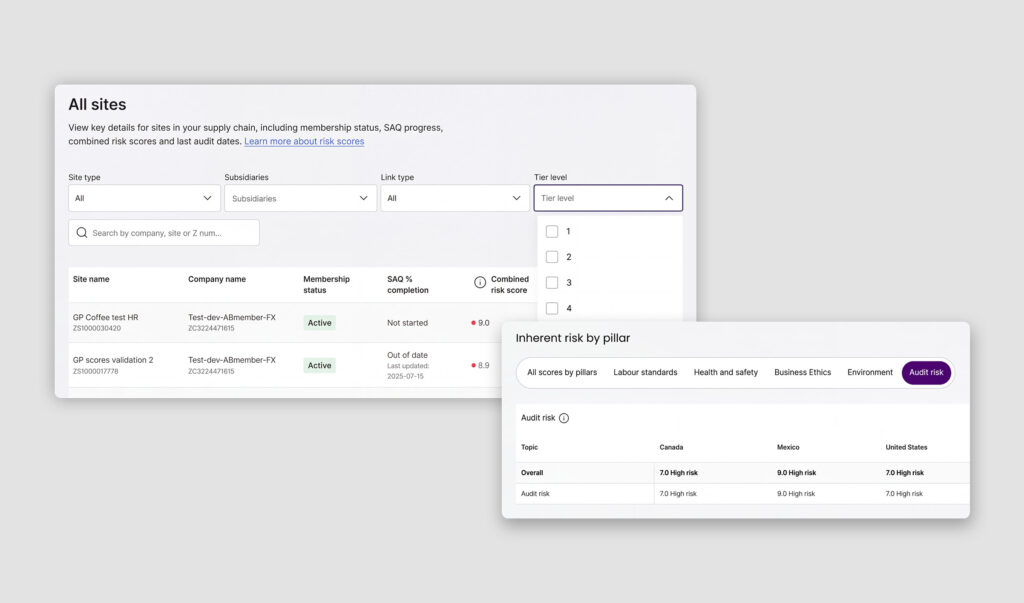
These capabilities launch alongside a comprehensive expansion of our risk assessment tool, with more precise risk scores now available across 15 topics for over 120,000 worksites currently registered on the Sedex Platform.
Using audit data to inform inherent risk insights
The Audit Risk pillar incorporates non-compliance patterns from over 250,000 SMETA audits across 115,000 sites in 106 countries, including the latest SMETA 7.0 data. This surfaces risks that may not be visible from contextual data alone, improving supplier prioritisation by highlighting issues reflected in actual audit findings.
Other new features now available to our customers include:
- The Wages Risk pillar now draws directly on SMETA data. Wage-related information from over 70,000 site-level SMETA audits is combined with expert external sources, providing more robust and validated inherent risk calculations to indicate where wages are most likely to be excessively low, or not compliant with legal obligations.
- Environment Risk Assessment reporting provides users with a single, structured view of environmental risk across their supplier worksites, to support scoping and prioritisation for environmental management and due diligence activities.
The hardest part of supply chain sustainability risk management is knowing where to act first. By combining authoritative global sources with site-level audit data across multiple sourcing tiers, we’ve built a platform that turns that question into a clear, evidence-based answer.
That’s the kind of intelligence that delivers real operational value, powering more precise decisions on risk prioritisation, compliance and supply chain resilience.
 Duncan Ellis,
Chief Product & Technology Officer
Duncan Ellis,
Chief Product & Technology Officer
With companies increasingly pressed to navigate home market, economic and regional supply chain turbulence, deeper visibility based on precise data supports the strategic decision-making necessary to navigate constant disruption.
Learn more about the Sedex Platform and its capabilities, or reach out to our team to discuss your team’s needs.
More news from Sedex