
SMETA (Sedex Members Ethical Trade Audit) is the world’s most widely used social audit, with around 67,000 audits carried out in 2025. We created SMETA in 2004 to give buyers and suppliers a single, shared methodology for assessing Labour, Health & Safety, Environment and Business Ethics at supplier sites. When you work with SMETA data today, you’re working with a standard we’ve owned, developed and continuously updated for two decades.
Key takeaways
- SMETA is the world’s most widely used social audit, with around 67,000 audits carried out in 2025
- SMETA assesses supplier sites against both local law and the ETI Base Code, an internationally recognised code of labour practice based on International Labour Organization (ILO) conventions
- A 2-pillar SMETA audit covers Labour Standards and Health & Safety. A 4-pillar SMETA audit adds Environment and Business Ethics
- SMETA isn’t a certification. It rewards transparency and focuses on continuous improvement rather than a pass/fail result
- Suppliers can share one SMETA audit with multiple customers through the Sedex Platform, which cuts duplication and gives buyers comparable data
- SMETA 7.0, launched in September 2024, introduced the Workplace Requirements, the Management Systems Assessment and Collaborative Action Required findings
What is SMETA?
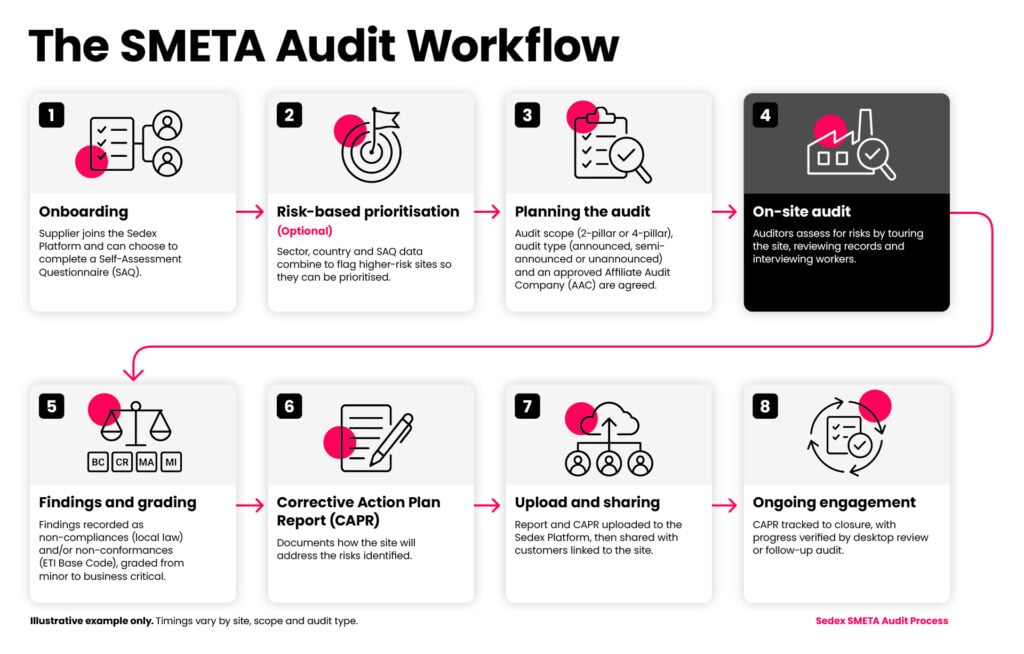
SMETA is a social audit methodology. Independent auditors visit a supplier site and assess it against two reference points: local law and the ETI Base Code. Where the two differ, SMETA applies whichever gives workers greater protection.
Auditors record a non-compliance where a site doesn’t meet local law, and a non-conformance where it doesn’t meet the ETI Base Code. A single finding can be both.
Every SMETA audit follows the same methodology, whatever the site’s country, size or industry. That consistency is what makes SMETA results comparable across your supply chain.
SMETA audits are carried out by Affiliate Audit Companies (AACs), independent third-party audit firms we’ve approved to apply the SMETA methodology. Once an audit is complete, the report is uploaded to the Sedex Platform, where the supplier can share it with multiple customers instead of each customer commissioning its own audit.
Why SMETA isn’t a certification
A SMETA audit isn’t a certification, and neither is Sedex membership. We built SMETA this way on purpose, to encourage transparency, collaboration and ongoing improvement rather than a single pass/fail moment.
Like SMETA, many certification schemes use corrective action plans. The difference is that certifications typically draw a line in the sand: a site passes as long as its non-compliances stay within a set threshold. We see identifying non-compliances as a positive outcome, because knowing where the risks are is how actions get taken and working conditions improve. There’s no penalty for transparency, only encouragement to keep making progress.
This approach fits naturally with human rights due diligence, where the goal is to identify, prioritise and address risks to workers over time rather than prove a site is risk free.
Why did Sedex create SMETA?

We created SMETA to reduce the duplication and inconsistency suppliers can face in social auditing.
Without a shared methodology, each buyer can end up running its own audit programme. A single site supplying multiple customers may face several audits covering the same ground, each with different criteria, scoring, auditors and reporting formats.
Sedex was founded in 2001 by a group of UK retailers to drive convergence in social audit standards and monitoring practices. Our members created SMETA as a centrally agreed protocol for monitoring performance against the ETI Base Code, and we launched it in 2004.
The more widely SMETA is accepted, the further a single audit goes. Every buyer that accepts SMETA reduces audit fatigue for its suppliers and gains a common language for discussing improvement.
What makes SMETA different from other audit methodologies?
- Labour Standards: working hours, wages, freely chosen employment and other core labour rights
- Health & Safety: site conditions and worker protection
- Environment: environmental management and impact at the site level
- Business Ethics: anti-bribery, anti-corruption and management systems
A 2-pillar audit covers Labour Standards and Health & Safety, while a 4-pillar audit adds Environment and Business Ethics. Most buyers now choose the full 4-pillar scope.
How has SMETA evolved since 2004?
| Year | What happened |
| 2001 | A group of UK retailers founded Sedex, aiming to bring social audit standards and monitoring practices into closer alignment |
| 2004 | SMETA launched as a single, member-agreed protocol for monitoring how sites perform against the ETI Base Code |
| 2005–2018 | The methodology was updated repeatedly as compliance requirements and buyer expectations evolved |
| May 2012 | SMETA expanded to a 4-pillar structure with the release of Version 4.0, adding Environment and Business Ethics |
| 2020–2023 | The methodology continued to evolve as compliance requirements and buyer expectations changed |
| September 2024 | SMETA 7.0 launched, the biggest overhaul in the methodology’s 20-year history |
| November 2025 | SMETA 7.0 was recognised by The Consumer Goods Forum’s Sustainable Supply Chain Initiative (SSCI) |
What changed in SMETA 7.0?

SMETA 7.0 introduced three major changes.
- The Management Systems Assessment evaluates whether a site has robust policies, ownership, training and monitoring in place for each Base Code area. This helps sites understand the possible root causes of existing issues and spot areas at higher risk of future non-conformance because of weak systems.
- The Workplace Requirements break the ETI Base Code down into clear, auditable clauses, so everyone understands what a SMETA audit covers and how each area is assessed.
- The Collaborative Action Required finding type recognises issues where remediation may need multiple stakeholders and longer timeframes, so Sedex members can work together on challenging issues.
How is SMETA continuing to evolve?

Continuous improvement applies to SMETA itself, not just the sites it audits. Every year, we invite all Sedex members to help shape the design and improvements we make to SMETA, so it keeps pace with their needs and with growing expectations for supply chain due diligence.
SMETA also sits at the centre of the Sedex Platform. Once an audit company uploads a SMETA audit, its results feed directly into that site’s risk profile and corrective action plan. That site-level visibility helps you move from a point-in-time audit to continuous, data-driven improvement.
We’ve also piloted SMETA for Service Providers with a small group of customers, extending site-level due diligence to a part of supply chains that’s often overlooked. SMETA for Service Providers adapts SMETA 7.0 for organisations whose workers deliver services at client sites, such as cleaning, security, catering and facilities management, or operate across transport depots, yards or routes under central management. It adds tailored guidance on sampling, workplace requirements and accountability while staying aligned with SMETA.
Get started with SMETA
Ready to go deeper on how SMETA works in practice? Speak to our team or your account manager.